Field Notes: Tracking Hidden Specifications in Premium Development Projects
This case log covers a product development tracking project rather than a standard pre-shipment inspection. Our engineering team was commissioned by a premium UK brand specializing in high-end thermal lifestyle gear to oversee the technical milestones of their custom-designed vacuum flasks.
Upon arrival at the manufacturing facility, the foreign trade representative noted that because the client demanded strict adherence to a proprietary high-end design, she personally managed the product’s technical details. She also emphasized that the facility ranks as a top-3 stainless steel vacuum bottle supplier in China, implying their in-house development and quality assurance capabilities required no external oversight.
Our engineer initiated the review in the conference room by auditing the client’s engineering drawings against the factory’s production samples, then proceeded directly to the processing workshop. During the physical audit of the components on the assembly line, we identified a critical structural discrepancy regarding the liner treatment.
The factory representative acknowledged the finding, stating:
*”This is indeed a latent defect. Once the inner and outer flasks are welded and assembled, it is completely invisible from the outside. While it degrades the ultimate thermal insulation performance slightly, typical consumers rarely benchmark it scientifically. Consequently, many factories cut corners or skip this process entirely to save manufacturing costs.”*
Technical Engineering Report
1. Defect Analysis
| Finding Analysis | Details |
|---|---|
| Product | Double-wall stainless steel vacuum flask / travel mug |
| Defect | Poor copper electroplating (or complete absence of plating) on the inner liner flask |
| Root Cause | Poorly maintained electroplating bath chemistry, or intentional cost-cutting by skipping the plating step |
| Consequence | Reduced thermal insulation performance due to increased thermal radiation loss |
| Corrective Action | Quarantine defective liners before welding; strip and re-electroplate |
| Frequency | ⭐⭐⭐☆☆ |
| Rework Difficulty | ⭐⭐☆☆☆ |
| Rework Collateral Risk | ⭐☆☆☆☆ |
2. Technical Risk Assessment
| Engineering Metric | Rating | Technical Implications |
|---|---|---|
| Frequency | ⭐⭐⭐☆☆ | Common in price-sensitive promotional runs; occasionally found in premium batches due to poor bath chemistry maintenance. |
| Rework Difficulty | ⭐⭐☆☆☆ | Low to moderate only if caught early in the component stage before the laser welding and vacuum evacuation steps occur. |
| Collateral Risk | ⭐☆☆☆☆ | Negligible structural risk to the steel shell itself, but poses a major commercial risk to brand reputation via failed thermal claims. |
Root Cause & Engineering Solutions
The Thermal Physics Behind the Defect
A premium stainless steel vacuum bottle supplier relies on three mechanisms to maintain temperature:
- Eliminating conduction (heat transfer through direct contact)
- Eliminating convection (via the vacuum gap between walls)
- Minimizing thermal radiation (heat transfer through infrared emission)
Hot liquids emit infrared radiation. To block this heat from escaping, high-end vacuum flask manufacturers electroplate a thin layer of pure copper onto the outer surface of the inner stainless steel liner. The bright copper acts as a thermal mirror, reflecting radiation back into the liquid.
Quantitative difference: Copper vacuum insulation can make a difference of up to 5°C (9°F) over 24 hours — a meaningful performance gap for a “high-end” product.
The Cause: The presence of dull, flaking, or entirely unplated areas on the liner indicates either poorly maintained electroplating bath chemistry (incorrect voltage/current densities) or an intentional cost-cutting measure to save on copper anode consumption and processing time. Without a uniform copper layer, thermal radiation rejection drops significantly, compromising the container’s final thermal insulation performance.
The Solution: Implement a strict internal quality gate immediately following the electroplating stage. All liners showing uneven plating thickness, oxidation, or exposed steel must be quarantined before reaching the welding station. Substandard components should be stripped and run through a re-electroplating cycle.
On-Site Evidence Gallery
The following technical snapshots were captured on-site during the workshop component audit, showing the exposed liner flask surfaces before final enclosure:
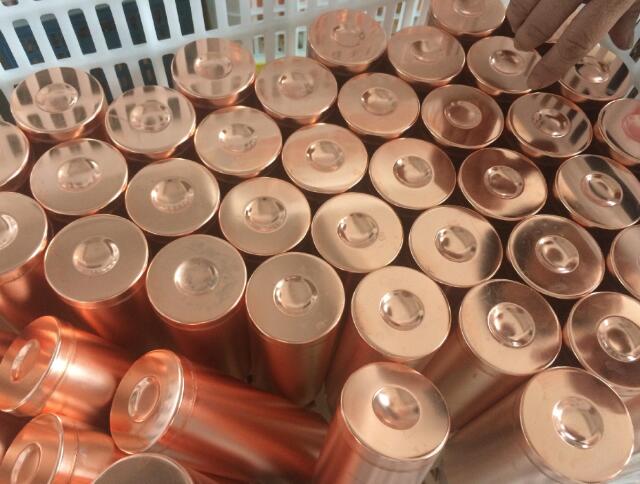
Overall view of the liner flask before welding — this is the only stage where copper plating can be inspected.

Close-up showing poor copper electroplating on the liner surface — uneven coverage and thin spots.
💡 QC Insight for Buyers
For procurement professionals and brand owners sourcing stainless steel vacuum bottles:
Copper plating is a functional requirement, not a “nice to have.” It directly affects the performance. If your supplier treats it as optional, that’s a red flag.
Inspect before welding. This is the only opportunity to catch plating defects. Once the liner is welded into the outer shell, the defect is permanent and invisible.
Quantify the difference. Copper plating can make a 5°C difference in performance over 24 hours. For a premium product, that’s the difference between “excellent” and “mediocre.”
Don’t assume “top three” means “flawless.” Even leading suppliers can cut corners on hidden features. Verify.
Include plating specifications in your contract. Minimum thickness, coverage area, adhesion requirements — make it measurable and testable.
Relevant standards: China has established standards for stainless steel vacuum containers, including BS EN 12546-1, which govern quality and performance requirements. Familiarize yourself with these if sourcing from Chinese suppliers.
The Bottom Line: Lessons for Your Next Order
This case study is part of our ongoing effort to share real, on-the-ground findings with buyers, brand owners, and sourcing professionals. The goal is simple: help you understand what can go wrong in production — and how to prevent it before it costs you time, money, and reputation.
This case is particularly instructive because the defect is invisible in the finished product. You can’t see it. You can’t feel it. The performance impact isn’t immediately obvious. And that’s exactly why factories cut corners here.
Key takeaway: The most dangerous defects are often the ones you can’t see. If you’re sourcing vacuum bottles — especially high-end ones — verify the copper plating before the liner is welded. That’s your only chance to catch it.
We hope these real case studies help you ask better questions, set clearer standards, and catch more issues before they ship.
Have a similar quality issue? Feel free to reach out — we’re happy to share our experience.
🔍 Looking for reliable product inspection service in China?
With 17 years of on-site QC experience, we can help you catch these issues before they ship at $168/man-day.
Learn more →